Brian Ferneyhough and the Art of Musical Impossibility
The 1970s refused to compromise. While the mainstream music world drifted toward the polished minimalism of Steve Reich or the ambient washes of Brian Eno, a violent impulse emerged within the European avant-garde. This was the birth of New Complexity. This movement rejected the easy pulse and the comforting melody. Instead, it sought confrontation. At the center of this sonic wreckage stood Brian Ferneyhough, a composer who treated the musical score not as a set of instructions, but as a site of extreme physical and intellectual struggle.
Critics often dismiss New Complexity as mere academic excess or noise for the sake of noise. They are wrong. This movement, which solidified in the 1970s, represents a deliberate attempt to push the boundaries of what a human being can execute on an instrument. Ferneyhough does not write music that is simply difficult; he writes music that occupies the very edge of human capability. He creates a tension between the written symbol and the physical act of performance, a tension that produces a unique, high-stakes energy. To listen to Ferneyhough is to witness an attempt to transcend the limits of the medium itself.
The Chaos of New Complexity
The New Complexity movement reacted against the perceived stagnation of post-war serialism. By the 1970s, the rigid structures of the Second Viennese School felt predictable. Composers like Ferneyhough, alongside figures such as Michael Finnissy, sought to break the predictability of the grid. They wanted to introduce a sense of chaos that felt controlled yet unpredictable. They replaced the clear, linear progressions of the past with a dense, hyper-active notation that mirrored the frantic nature of modern consciousness.
This is not a chaos of randomness. It is a chaos of extreme density. In a Ferneyhough score, every note carries a weight of information that can overwhelm the eye. The notation does not merely suggest a melody; it dictates a hyper-specific set of micro-gestures. This approach destroys the listener's ability to find a steady beat or a recognizable motif. Instead, the listener encounters a thicket of sonic events. You do not follow a theme through a piece of music; you navigate a storm of fragmented signals. The chaos is structured, but its structure evades easy comprehension.
The composer uses notation to obstruct the perception of a steady meter or pulse. When a performer looks at the hyper-active page, they do not see a rhythm they can tap their foot to. They see a dense thicket of symbols that demand constant, rapid-fire attention. This creates a sense of perpetual instability. The music feels as if it is constantly on the verge of collapsing into total disintegration, yet it maintains a rigorous, albeit fragmented, internal logic. It is a controlled explosion of musical information.
The Mathematical Nightmare of Nested Tuplets
If the notation is a thicket, the rhythm is a mathematical labyrinth. The primary tool Ferneyhough uses to destabilize the temporal experience is the nested tuplet. This is not a simple triplet or a basic quintuplet. He employs layers of subdivisions within subdivisions. You might find a septuplet nested inside a quintuplet, which itself sits within a larger, irrational grouping. This creates a rhythmic instability that defies standard notation. The player must navigate layers of conflicting pulses that never quite align into a hyper-predictable pattern.
Irrational rhythms, such as 5:7 or 7:5 ratios, further complicate the temporal experience. These ratios ensure that the rhythmic relationship between different instruments remains in a state of constant friction. One instrument might play a pattern based on a five-beat grouping while another follows a seven-beat cycle. They rub against each other like tectonic plates. This prevents any sense of a shared, unified pulse. The result is a sense of temporal vertigo. The music exists in a state of flux, where the very concept of time feels liquid and unreliable.
"The rhythm is not a container for the notes, but a source of friction that prevents the music from ever settling into a comfortable state of rest."
This mathematical density serves a specific purpose. It forces the performer to abandon the idea of a "beat" and instead focus on the microscopic shifts in intensity and duration. The rhythm becomes a texture rather than a framework. By using these complex ratios, Ferneyhough ensures that the music remains in a state of constant, unresolved tension. The listener cannot settle into the music because the music refuses to settle into itself.
Pushing Toward the Limit-Experience
Ferneyhough's work operates on a philosophical concept known as the "limit-experience." This is the point where the physical capacity of the performer meets the extreme demands of the score. The music pushes the musician toward the edge of their physical capability. It is an athletic feat as much as an intellectual one. The extreme technical strain placed on a musician's breath and manual dexterity is not an incidental byproduct of the composition; it is the very point of the music.
Consider the woodwind player facing a Ferneyhough passage. They must manage rapid-fire articulation, sudden leaps in register, and a microtonal notation that requires them to navigate pitches between standard semitones. They cannot rely on standard fingerings or habitual patterns. They must find new, often uncomfortable, ways to manipulate their instrument. The physical strain is visible. You can see the effort in the tension of the embouchure, the frantic movement of the fingers, and the desperate struggle for breath. The performer reaches a state of near-exhaustion.
This struggle is where the music lives. If the performer plays the notes perfectly without any sense of struggle, the music fails. The essence of the piece lies in the visible and audible effort to overcome the impossibility of the notation. The microtonal demands add another layer of difficulty. The performer must possess an almost superhuman pitch accuracy to navigate the intervals that fall between the cracks of the Western scale. This is not about playing "out of tune"; it is about the precise execution of a highly complex, non-standard pitch language. The music exists in the friction between the performer's skill and the score's impossible demands.
Transit and the Architecture of Density
The 1980 composition Transit for large ensemble stands as one of the most potent examples of this architectural density. In Transit, Ferneyhough does not merely use complexity as a decorative element. He uses it to build a massive, imposing structure of sound. The piece functions as a study in the accumulation of detail. Every instrument contributes to a larger, overwhelming mass of information that feels both incredibly heavy and strangely translucent.
The density in Transit is not uniform. It fluctuates, creating a sense of pressure and release that differs entirely from the tension and release of a classical symphony. The "release" in Ferneyhough's work is often just a change in the type of density. The piece moves through different layers of complexity, each one more demanding than the last. The architecture of the piece rests on these shifts. One moment, the ensemble is a fragmented collection of soloistic gestures; the next, it is a monolithic wall of hyper-dense notation that seems to press against the very limits of the concert hall's acoustics.
Listening to Transit requires a surrender of the desire for narrative. There is no development in the traditional sense. There is only the unfolding of complexity. The piece moves through various states of being, each one characterized by a different level of rhythmic and harmonic friction. It is a work that demands total immersion. You cannot observe Transit from a distance; you must be caught within its mechanism. The piece uses its large ensemble to create a sense of overwhelming scale, where the sheer volume of notation creates a physical presence in the room.
The London Sinfonietta and the Survival of the Performer
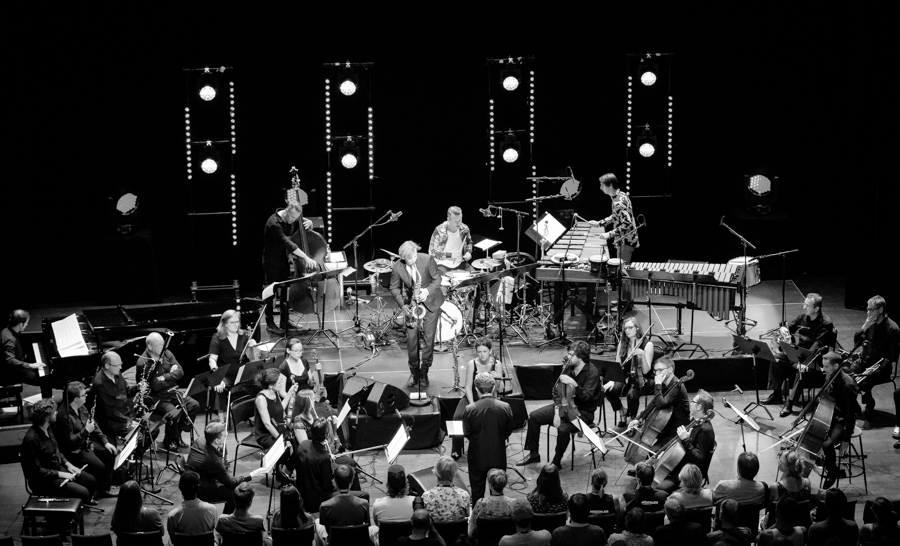
A composer can write the most complex score in the world, but without a dedicated group of performers, it remains nothing more than silent ink on paper. The London Sinfonietta plays a vital role in the survival and realization of this repertoire. For decades, this ensemble has taken on the role of the frontline, interpreting and performing the most difficult works of the contemporary avant-garde. They translate the mathematical nightmare of the score into a tangible, audible reality.
The London Sinfonietta does more than just play the notes; they inhabit the struggle. The performers in this ensemble possess a specialized set of skills: an extraordinary level of technical dexterity, an acute sense of microtonal pitch, and the mental stamina to navigate hyper-dense rhythms. They bridge the gap between Ferneyhough's abstract mathematical concepts and the physical world of sound. Without an ensemble with this specific level of expertise, the New Complexity movement would have remained a theoretical exercise.
The survival of the performer in this context is a feat of endurance. They face the same physical and mental pressures that the composer intends. The London Sinfonietta does not shy away from the technical strain; they embrace it as part of the musical process. By performing these works, they validate the composer's vision of the "limit-experience." They prove that while the music may be "impossible" in a purely theoretical sense, it can be realized through extreme human dedication and skill. The history of modern classical music is the history of performers like those in the London Sinfonietta rising to meet the challenges of composers like Brian Ferneyhough.